

Join us on Climate Action Week on 25th June 1:00pm – 2:30 BST for a live discussion on intimacy and climate change in “Let’s Get Intimate”. Get your tickets here. The tickets are donation-based, it is recommended you pay minimum £5 to support the work.
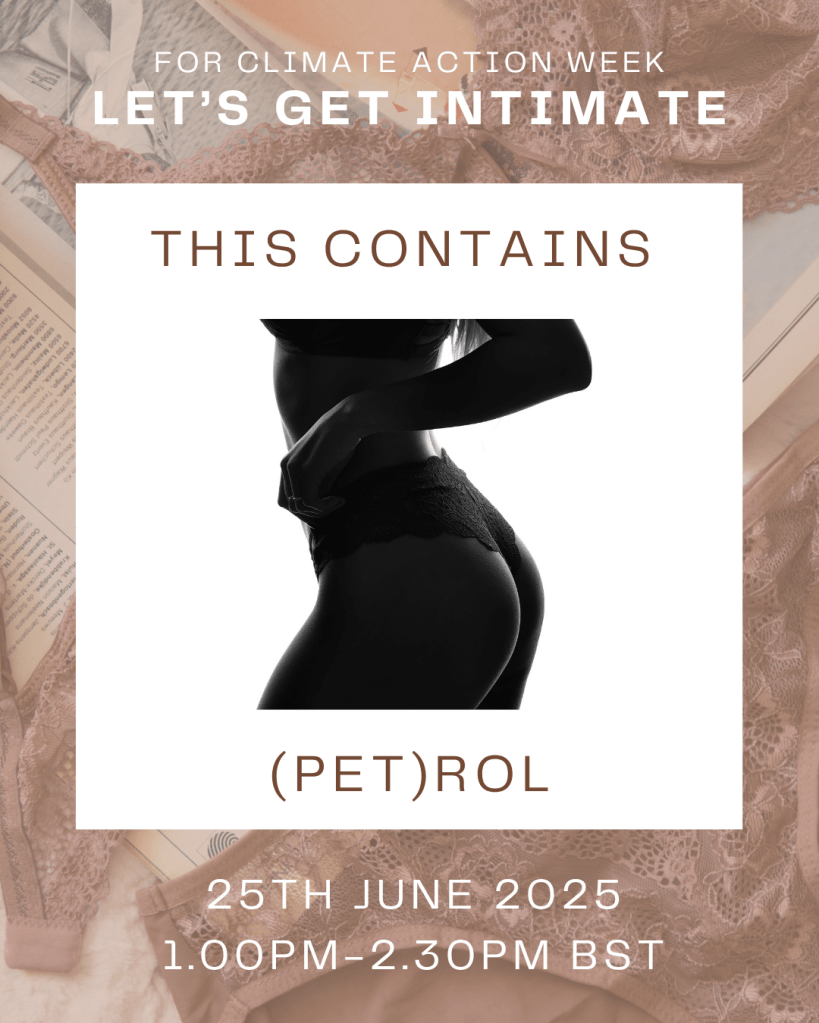
Confession, usually, when I go to the shop to buy panties and lingerie, I do not even think about whether I am making a sustainable, plastic-free choice. The price and style of the panties are the main things I look. I think in sustainability, we have not got intimate.
When it comes to sustainability in fashion, it is more encouraged to have a second-thought about buying jeans than having a second-thought buying plastic underwear. This week I delivered a workshop at UCL Sustainability Leadership Conference, I decided to rip off the band-aid on what we put close to or in our private parts.
So, let’s talk sex and let’s talk about periods more in this movement. More crucially, why does big oil have such strong real estate in our private parts?
PFAS and feminine hygiene
Research shows that pads and tampons are presented to be “feminine hygiene”, yet they are far from “true hygiene”. These products contain so many chemicals that, like cigarettes, they need to come with a warning label.
Feminine hygiene products have been found to contaminated with PFAS, which stands for per- and polyfluoroalkyl substances. This is known as a “forever chemical”, meaning that it does not break down in nature.
According to U.S. Environmental Protection Agency, these chemicals are linked to a range of health ills, which include: decreased fertility, high blood pressure in pregnant people, increased risk of certain cancers, developmental delays and low birthweight in children, hormonal disruption, high cholesterol, reduced effectiveness of the immune system. This also leads to the decreased efficacy of vaccines.
Endocrine Disrupting panties

Our panties, and lingerie also popularly contain polyester, nylon, elastane, and polyamide for lace. Plastics releases microplastics into our waterstreams, and the water we consume. On a biological level, these microplastics act as hormone/endocrine disrupters. Also please note that research on the impacts of microplastics on mammal health, which includes humans, is still very early.
Endocrine disrupters mean that the structure of the chemicals are similar to the hormones we naturally produce. This means, hormone receptors – which are molecules inside us that respond to hormones – end up binding to microplastics instead of hormones.
Fashion and Big Oil are not Separate Industries

How did we get here? Well, we see the fashion industry, and feminine hygiene as separate from the oil and gas industry rather than an extension of it.
In this short film I created, I go through significant inventions that define today’s fashion industry. Nylon is a popular fibre that is popular used in lingerie and panties today due to its durability. Nylon was invented by E.I Du Pont Company in 1938.
At the time, it was promoted as the “first man-made organic textile fibre” made from “coal, water and air”. It was also promoted for its strength of being “as strong as steel, as fine as the spider’s web”. This is made from polyamide monomers, which is a plastic extracted from crude oil.
In 1941, the chemical Polyester was invented by W.H Carothers, W.K. Birtwhistle and C.G. Ritchie. This plastic is made from petroleum extracted from crude oil.
In a sexy marriage between fast fashion and sexual empowerment, we have casually made petroleum “sexy”. What is defined as a “racy” in fast fashion lingerie made up of polyester and polyamide.
From ASOS Website
The Traditional Voice of the Climate Movement
In the climate movement so far has been significantly defined by a focus on no-new oil fields, anti-fracking and the switch to renewable energy. In my workshop at UCL, I took the students to a new terrain of what about big oil its encroachment on the flesh, sex, menstruation and intimacy and how community engagement on this issue could facilitate a phase-out events amidst the cost of living crisis.
The main avenue to phase-out big oil in the intimate is sustainable, plastic-free and circular alternatives to become more available and affordable to customers. This requires creating a consumer rights presence for companies to invest in bringing sustainable options to market that are decoupled from big oil. Gender-lens investment now means these products have the chance to become cheaper over time for the average customer, which can then offer range of styles that compete with plastic counterparts.
It also takes a popular movement in redefining what is sexy. Is the environmental movement willing to be raunchy, racy and sexy? Sex positivity and environmentalism are not opposites, it is simply untapped because the movement is prudish, bureaucratic and overly-technical.
So right now, big oil owns what is sexy, fashionable and intimate. We all pay the costs in compromised bodily functioning.
Imagine if the environmental movement claimed sexiness, racy aesthetics, and unapologetic pleasure as part of its core identity. Here are a few companies giving consumers the option to be sexy, circular and plastic-free.
- ColieCoColieCo produces ethically-made, sustainable lingerie, underwear and swimwear in their own in-house studio in Sagres, Portugal.They aim to change the way people think about sustainable fashion. Because they believe that women shouldn’t have to choose between aesthetically-pleasing but exploitative fast fashion, and sustainably and ethically produced but drab, grey and brown alternatives.Alternative materials in use: TENCEL™ Lyocell, reclaimed Polyester, Bamboo
- Luva HuvaLuva Huva practices circular production, leaving no waste. The lingerie is made from recycled, repurposed and natural fabrics. When the final knicker has been cut, the company donates fabric ends to local schools for craft projects. This is lingerie designed to last, but they offer a repair service for customers.Alternative materials in use: Organic Cotton, SeaCell, Bamboo, Lace
- Mighty EveReusable Mighty PadsTM are your dependable partner for managing flows day or night. Made with a super-soft bamboo jersey, leak-proof PUL lining, secure poppers, and silicone backing for stability, their pads ensure that leaks are kept under control, so you can have confidence from the inside out. The products come in a bundle of period underwear and Mighty PadsTMAlternative materials in use: Bamboo
 Uninhibited Development Solutions